A bit about me
I make things, and I fix things. Code is the part I get paid for, but it's far from the only part.
I'll try anything three or four times. Every new challenge is a chance to pick up new skills, or to practice old ones. And each new skill has a way of informing many others.
Jack of all trades, master of none,
though oftentimes better than master of one.
Lessons I've learned...
-
Start with the recipe, then make it yours
I enjoy cooking: starting from a step-by-step recipe, and then tweaking it until it becomes my own variation. A new recipe might make it into standard rotation, or it might be a complete failure and an excuse to order take-out. Even when it doesn't go right, I can still learn what not to do next time.
I learn how a tool wants to be used before I start bending it. And an experiment that fails has still told me something.
-
Take what's broken, make it better
My latest thing has been restoring and upcycling furniture. There's just something about turning trash into treasure; breathing life back into something. It's also an economical way to create one-of-a-kind pieces for my own home.
Given the choice, I'd rather start from scratch. But some things are unique, and those are worth preserving. A lot can be achieved just by removing what's broken. Many of my projects are exactly that: legacy code, stalled migrations, and the sites nobody else wants to touch.
-
Bold, simple, and colorful
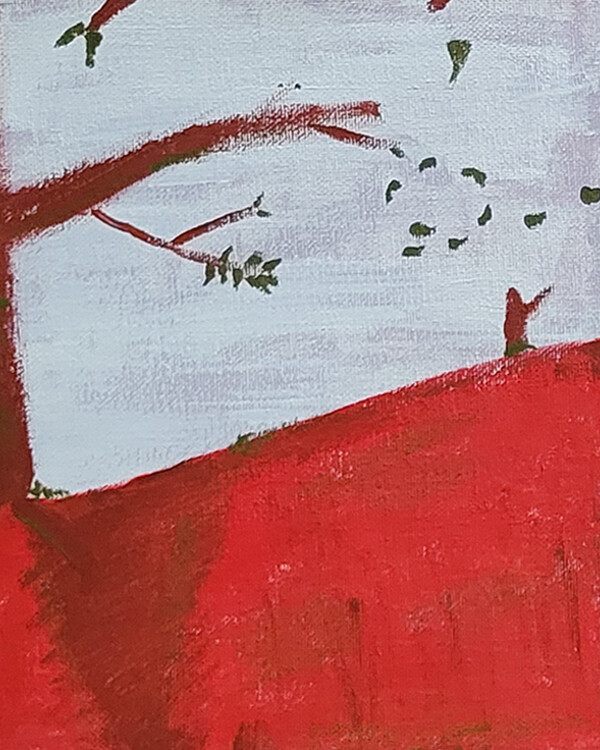
I've dabbled a bit in acrylic painting. I don't have a lot of technical skill when it comes to painting, but I do enjoy the bold, colorful, simple style I've cultivated. When inspiration strikes, the possibilities are endless.
It's the same aesthetic I bring to an interface. If someone can't tell at a glance what a thing is and what it does, no amount of polish will save it.
Seeing both sides
Programming has always come pretty naturally to me, but I never thought it was going to be the thing I'd be when I grew up. I knew my way around whatever language the old TI graphing calculators used, and messed around with Geocities and Angelfire sites back in the early days of the web.
My earliest jobs were in a pizza place, doing prep, as a line cook, and even driving delivery. I've also worked in a variety of customer service roles (Hallå IKEA!), community theater production, law offices, and even for the American Medical Association. In every role, I looked for the opportunity to improve how things were done.
I came into web design sideways, as an administrator for a small graphic and web design company (Artistic Digital in Evanston, IL). At first I was mostly concerned with billing, and communicating with the clients. I was fortunate to be able to apprentice under the owner on some design jobs: trade show banners, technical illustrations, and web sites. HTML content updates turned into PHP templates, CSS tweaks, and JavaScript functionality. Before I knew it, I was developing whole sites from scratch, start to finish.
Later, at Sandstorm Design in Chicago, I took on bigger and better web projects, and grew from a front end developer into a full stack one. Now I work for Apti, where I look after their LMS platform, Knowledge Direct, the AWS infrastructure it runs on, and the corporate WordPress sites.
All of this is to say that before I was the one writing the code, I was the one answering the phone, sending the invoice, and explaining to a client what could and couldn't be done by Friday. I've sat on both sides of most of the conversations a project involves, and that lets me see what others might miss.
The fastest, most efficient code in the world doesn't matter if it looks like something out of Netscape Navigator. The shiniest, prettiest interface doesn't matter if users can't figure out how to, well, use it.
My biggest advantage is translating between the human and the technical; speaking the language of human needs, and understanding the technology to make them real. The most important thing is knowing how to ask the right questions.